The Industrial Painting Process
Industrial painting is a specialized service that requires technical expertise, strict safety standards, and the right tools for the job. From coating pipelines and machinery to restoring surfaces in manufacturing facilities, this work is built on precision and planning. You can’t simply hand off the project to anyone with a paint sprayer. You need an industrial painting company with knowledge of surfaces, materials, and coating systems. Learn more about the methods, process, and benefits of industrial painting.
Why Industrial Painting Matters
Just how important is industrial painting and coating? Consider these benefits that support safety, compliance, and performance:
- Coatings protect against corrosion, chemical exposure, and high heat.
- Moisture-resistant finishes prevent mold in damp environments
- Smooth, sealed surfaces improve sanitation in food handling, pharmaceutical, and hazardous material applications.
- Painted equipment runs longer.
- Clearly marked surfaces enhance safety.
- Well-maintained spaces project professionalism, which matters during audits or client visits.
Common Industrial Painting and Coating Methods
Different surfaces and exposures require different techniques. Some are designed for speed, while others focus on durability, precision, or environmental safety. Here are the top methods used by industrial painting contractors near you.
Spray Painting
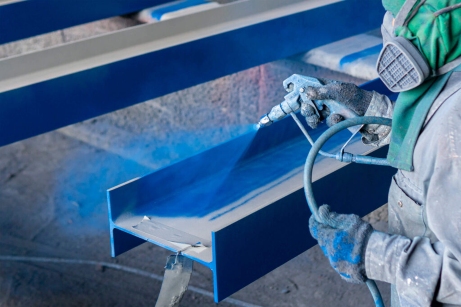
Spray painting is fast and highly adaptable, making it ideal for large surfaces, complex equipment, and metal structures. Airless sprayers pump paint at high pressure to produce thick, even coatings without the need for compressed air. High-volume low-pressure (HVLP) systems create a softer spray, which is necessary for surfaces that require finesse to look right.
Electrostatic Coating
Electrostatic spray systems offer even more uniform and complete coverage. Charging the paint particles and grounding the object being painted helps the coating cling to every curve and crevice. This is especially effective for machinery with complex shapes or hard-to-reach components.
Powder Coating
Powder coating involves applying a dry powder to metal surfaces and baking it until it cures into a smooth, durable finish. It’s often used when coatings must be resistant to chipping, chemicals, or frequent cleaning. Common applications include racking systems, machine parts, and enclosures.
Thermal Spraying
When equipment operates in high-wear or high-temperature conditions, thermal spraying helps to extend its service life. These techniques project molten or semi-molten material onto a surface to build dense, highly durable coatings. There are several forms, including high velocity oxygen fuel (HVOF), plasma spray, and arc spray, each offering a different balance of hardness, bond strength, and thermal resistance. These coatings are typically used on turbines, rollers, cutting tools, and valves.
Dip Coating
In dip coating, components are immersed in coating baths for full surface coverage. This ensures complete protection, especially on parts with intricate geometries or internal channels. It’s frequently used for the mass production of small parts that must meet uniform coating standards. The process can also improve efficiency when multiple identical items need consistent results.
Brush and Roller Application
These methods allow for detailed work on edges, joints, and hard-to-reach surfaces where overspray might be a concern. They’re also useful in environments with limited ventilation or when applying a high-solids coating that requires manual control.
The Industrial Painting Process
Industrial sites have complex environments with unique conditions. Every detail, from the equipment layout to the potential for chemical exposure, affects the choice of coating and application. Here’s how full-scale industrial painting typically unfolds.
Site Evaluation
A skilled team evaluates your site, looking at substrates, age of the equipment or structures, prior coatings, exposure to heat or chemicals, and safety considerations. Temperature, humidity, and ventilation also influence coating performance and curing times. Site-specific challenges are flagged early so solutions can be built into the schedule.
Surface Preparation
Surface prep determines the success of the entire project. Industrial painting contractors rely on various methods based on the material and coating system:
- Abrasive blasting removes rust and contaminants from steel and heavy machinery while creating a profile for coatings to grip.
- Pressure washing clears away grease, dust, and flaking paint.
- Chemical cleaning is used when abrasive techniques could damage sensitive components.
- Dry ice blasting or sponge blasting may be used to minimize residue and airborne contaminants in facilities with strict environmental requirements.
Priming
A primer seals porous materials, combats corrosion, and promotes adhesion. These properties support the topcoat and lengthen its service life. Industrial painting companies use primers tailored to the environment:
- Zinc-rich options are suitable for corrosion-prone steel.
- Epoxies lend chemical resistance properties.
- Moisture-cure urethanes may be necessary for damp or humid spaces.
Coating Application
With priming complete, it’s time to build up the coating system. This phase may involve multiple layers. First, the intermediate coats build thickness and improve barrier properties. Then, the topcoat provides chemical resistance, UV stability, or color coding. Urethane, in particular, is often selected as a topcoat for its durability and gloss retention.
Safety is tightly controlled throughout, with ventilation, fall protection, and PPE required. On active sites, industrial painting crews often coordinate with plant schedules to minimize disruption.
Curing and Inspection
Curing is where good coating systems are won or lost. Heat, air movement, and time all affect the curing process. Even fast-drying formulas require proper handling.
After curing, coatings undergo a thorough inspection. Trained technicians test for film thickness, adhesion, gloss, and uniformity. Areas with visible flaws, insufficient coverage, or pinholes are corrected immediately.
Maintenance Planning
Once painting is complete, the focus shifts to preservation. Industrial facilities can’t afford repeat shutdowns due to coating failure. To prevent this, many industrial painting contractors provide scheduled inspections and ongoing maintenance support. Routine assessments help spot early signs of wear, chalking, or corrosion and address issues before they escalate.
Why Choose FCS Industrial Solutions?
We are a trusted family-owned building service contractor serving the Mid-Atlantic and Southeast regions since 1988. We bring big‑firm capabilities while maintaining a small business mindset when it comes to customer service and responsiveness. Our highly trained professionals strive to exceed your expectations and beat your deadline once the project begins. Contact FCS Industrial Solutions today to discuss your industrial painting needs. We’ll get you started with a free on-site quote within 72 hours of your request.